
Tea Time

“Religious liberty is so blended with civil, that if one falls it is not expected that the other will continue.” Charles Turner
The wave of patriotic sentiment that swept the American colonies during Britain’s Seven Years War against France suddenly gave way to a climate of resentment and distrust in the days and weeks following the Boston Massacre on March 5, 1770. Unfavorable taxation and trade policies were being implemented by Parliament with neither consultation or representation. In addition, the English troops that had been left in America under the pretense of defending the colonies from any remaining French and Indian threats were now being used as part of the Crown’s domestic policy to bring the colonies into subjection. This caused a rapid escalation in hostilities between the people of Boston and the British soldiers now stationed there.
Thousands of mourners flooded Boston as the city buried the victims of the massacre. Even in the days immediately following the shootings, all observers concluded that the situation had changed dramatically. The unthinkable had just occurred, and many of the wealthy and religious citizens of Boston that had remained indifferent to the growing conflicts between the colonial radicals and British officials now lined up solidly behind the militants. Extreme events now called for extreme measures. And the man that many in Boston looked to in the days following the tragedy was Samuel Adams.
Sam Adams was recognized as Boston’s leading antagonist and opponent to British policy and presence. A spiritually devout man, he had been significantly influenced by George Whitefield’s preaching while he was a student at Harvard, and seriously considered entering the clergy. His senior thesis anticipated his radical politics, arguing that even the highest lawful authorities could be resisted when the powers of the government threatened the safety and liberties of the commonwealth. At his father’s death, he inherited the family malt business, but his passion was politics.
A master political strategist, he utilized the powers communications and propaganda to shape public opinion. In the 1750s, he and a group of friends formed a secret society and began publishing the Independent Advertiser, by which they attacked the British government’s policies and appointed officials. He would later learn much from his mentor, James Otis, a Boston attorney that was one of the few voices opposing the expansion of governmental powers and opposed the increasing use of writs of assistance. These legal documents granted customs officials broad and undefined authority to search and confiscate property under the guise of looking for smugglers who conducted business around the Boston harbor. Otis would be a regular contributor to the cause, including the publication of his 1764 tract, Rights of Colonies Asserted and Proved, which argued in response to the Sugar Act that the Parliament had no right to tax the colonies. But his wild mood swings made him very unpredictable, and most turned to Adams for leadership.
The leadership abilities of Sam Adams were not confined to his writings; he was the consummate people person. He could as easily talk with the dockworker at the harbor as he could with members of the elite of Boston society. He was well respected because he took his Congregationalist religion seriously, and in his job as tax collector he gained many friends by his lax enforcement during times of economic hardship. With an ability to craft a message, formulate a political strategy, and then mobilize the forces to make it happen made Sam Adams feared by the British and respected by the masses.
Adams’ greatest success in his early days as an activist was the creation of the Sons of Liberty. This organization served on the front lines of the cause of liberty in Boston, and their success in forcing the British to consistently reverse their policies prompted other secret societies around New England to adopt their strategies. The Sons of Liberty were able to translate their popularity into momentum to obtain seats in the Massachusetts House and take control of the Boston Town Meeting.
It was after the passage of the Stamp Act that the Sons of Liberty first show their muscle. Staging regular demonstrations in Boston around the “Liberty Tree”, they were also behind the coordinated campaigns to pressure colonial citizens from accepting positions as Stamp agents. Riots would regularly be directed against those that resisted, and several agents reluctant to resign their commissions had their houses and offices torn down. When the crowds would overstep their bounds, Adams would immediately denounce the riots and distance himself from their actions. But few doubted who controlled the mobs.
The Sons of Liberty also pushed for the Stamp Act Congress, which gave the activists connections with the political leaders in the other colonies. They also coordinated with other like-minded groups in the area, such as the Loyal Nine, a group of merchants dedicated to preserving the freedom of the colony. After Lord Alfred North moved British soldiers into Boston, Adams set up a news service, Journal of the Times, to recap supposed abuses committed by the soldiers against the populace, which was frequently laced with some suggestive and unflattering storytelling. Another active member of the Sons of Liberty was the silversmith, Paul Revere. After the Boston Massacre, Revere would make an engraving commemorating the event, which would spread his name up and down the Atlantic seaboard.
One additional success the Sons of Liberty enjoyed was the campaign against Boston merchants that purchased and sold goods imported from England. Their hope was to turn the mercantilist system against the mother country by denying them the trade they needed to achieve favorable balance of trade. They organized effective boycotts against uncooperative merchants, so much so that even the acting Massachusetts governor, Thomas Hutchinson, and his sons refused to violate the Sons of Liberty’s embargos.
One of the prime beneficiaries of the non-importation agreements was the Boston merchant, John Hancock. Inheriting the family business from his uncle and now one of the richest men in the colonies, Hancock ran a booming trading business that relied on smuggling products into America. He frequently ran afoul of the British customs agents, and as early as 1768 he was refusing to pay customs for the goods on his ships. Even though Hancock had been defeated by Sam Adams for a seat in the colonial assembly, he would later win another seat and become a close friend and partner with Adams. His deep pockets would come in handy for the struggling movement. His role in the anti-government circles that John Witherspoon would grant him an honorary degree from the College of New Jersey in 1769 more for his political activities than his depth of knowledge.
Despite the repeal of the Townshend Duties and the easing of tensions in Boston, Sam Adams and other Sons of Liberty stayed busy. In 1772 Adams persuaded Massachusetts towns to put into writing their grievances against Great Britain and statements of American rights and to regularly correspond with each other on such matters. The other New England colonies soon followed suit. The Virginia assembly led the way in the South by setting up a network of correspondence for the entire colony and suggested that all the other colonies do the same. These Committees of Correspondence were very important. They became a way of reporting and sharing news outside of the regular newspapers. They could also be used as a means for the colonies to take common stands on issues and take action together on such matters as they thought necessary. This coordination between colonies would be crucial in making appeals to King George in response to the policies imposed by his ministers. As soon as new taxes and schemes were devised, the colonies would have a formal reply at the ready.
Tensions between the colonists and the British government continued over the next few years. Tempers would flare and then subside. But it was clear that a new radicalism was emerging.
Lord North had recommended that Parliament pass the Tea Act of 1773. This was passed not so much to regulate trade or even to make money, but mainly to help the British East India Company get out of financial trouble. This law allowed the company to export tea directly from India to America without requiring it to be unloaded in England first. This would cut the company’s costs considerably. The tea would still have a small tax of three pence per pound on it, but it would be sold in the colonies at a price lower than one could buy it for in England. King George III had insisted on this tax in order to uphold Parliament’s right to tax the colonies. Even with this tax, Americans would pay less for British tea than they were paying for tea smuggled from Holland.
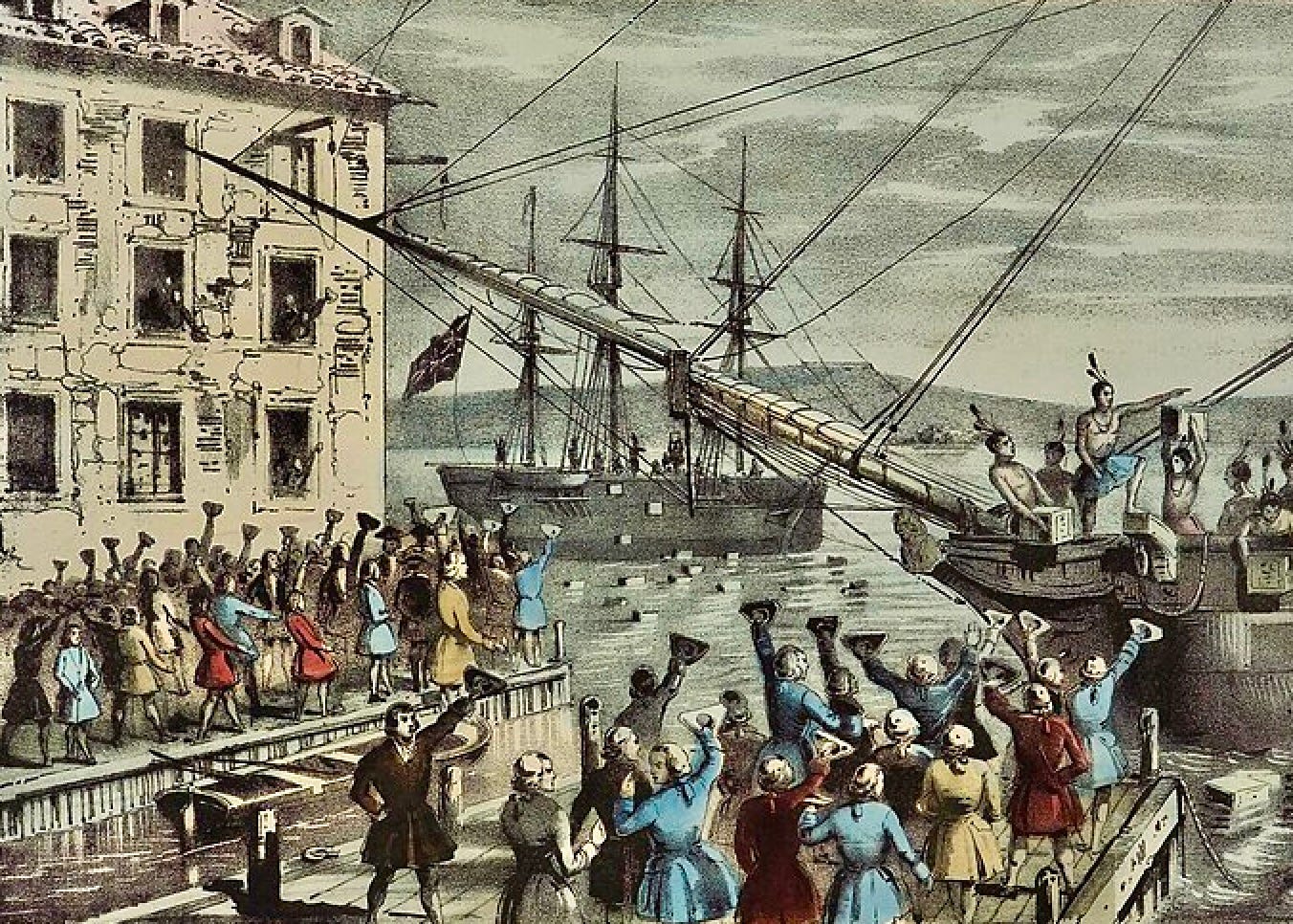
Both the king and Lord North failed to understand the American position. Americans were not willing to pay anytax levied by Parliament, no matter how small it might be. It would also put smugglers, like John Hancock, out of business because the Dutch tea that they sold would not be able to compete with the new British monopoly. The arrival of the East India tea in American ports was met with fierce and determined resistance. Charleston port officials seized the tea, kept it in the customhouse and later sold it. New York and Philadelphia refused entry to the tea-laden ships. When Governor Hutchinson of Massachusetts refused a petition to send the tea ships back to England, a group of the Sons of Liberty disguised themselves as Mohawk Indians and boarded the ships on the night of December 16, 1773, and dumped 342 chests of tea into the harbor. Not one participant in this Boston Tea Party took any tea with him, nor did he destroy any property except for the tea itself. They even replaced the locks on the tea chests after they had emptied them. Hutchinson was furious – his sons and friends held the Massachusetts monopoly for the East India tea. He was soon writing to London asking for drastic action.
But he was soon to discover, the dumping of the tea was a symbolic gesture of a much deeper political rift than he could have ever imagined. If two years later at Lexington and Concord, a “shot heard around the world” would be fired, it was on that day in Boston harbor that the die was cast. The War for Independence was now very nearly inevitable.