
Salutary Neglect

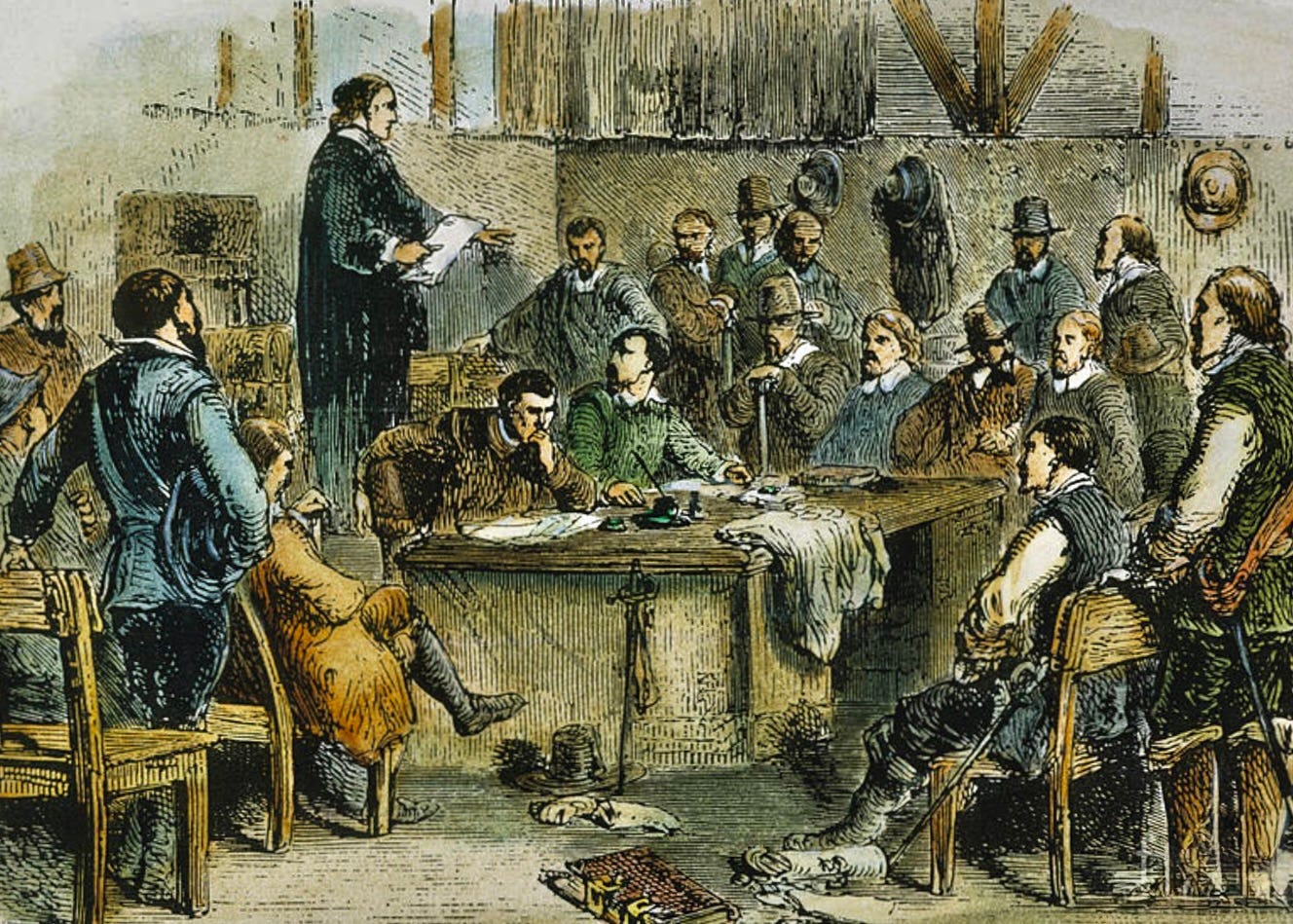
One contributing factor to the birth of a uniquely American culture during the Colonial Era was the British administrative policy of “salutary neglect” which was enjoyed by the pioneer settlers right up until the years immediately preceding the War of Independence. With only a few rare exceptions, the colonies were left alone to develop on their own. This laissez-faire attitude extended not just to political affairs, but also to culture, law, religion and economics.
From the beginning, the Crown had nothing to lose from the colonial ventures. Although the Stuart kings made massive land grants in the New World during the 17th Century to their friends and political allies, those parties bore the full weight and risk of their investment. At no point did the Crown subsidize their colonies, unlike the Spanish and French. This markedly different English stance towards their colonies was reflective of their expansionist, decentralized and Protestant tendencies. France, England’s mortal enemy during this period, maintained a provincial, centrally controlled, and statist colonial policy. As tensions escalated between the French and the English during the “Old Wars” (or the “French and Indian Wars” of 1689 to 1763 as they were known in the American theater), these differences in colonial policy would play a crucial role as the conflict between Britain and France was played out at points all over the globe, not just in the New World.
But salutary neglect was not nearly so much a deliberate strategy as it was a matter of default. During the one hundred-fifty years prior to the War of Independence, England and Scotland were embroiled in the most difficult internal political battles in the countries’ existence. These political conflicts reflected the growing religious hostilities that were already tearing Western Europe apart. While the English and Scots monarchies were at their height during the Elizabethan and early Stuart eras, they eventually sundered the two kingdoms with civil war, fell out of power, were restored, suffered through succession crises, endured yet another round of civil wars and insurrections, and then they were in the end, though now united, left severely limited.
The difficulties began during the reign of James I, the successor of Elizabeth I. Since Elizabeth died in 1601 without an heir, the throne reverted to her cousin, James Stuart, who was then James VI, King of Scotland. While James had been raised under the tutelage of the leading Scottish Presbyterian divines of the day, he quickly adopted and acted on the Roman Catholic doctrine of the divine right of kings. An absolutist monarch, he passed on that heritage to his son, Charles I, who tried to enforce his will as law and ran headlong into a confrontation with Parliament over his rightful powers. In 1628, after attempting to raise taxes without consent of Parliament and jailing several of its members, Charles was forced to concede to the Petition of Right, which established the right of “no taxation without representation.”
After his political thumping in 1628, Charles refused to call Parliament again until 1640, when he needed to raise money to defend the realm from a Scottish invasion. The Scots were responding to efforts by Archbishop Laud, primate of the Church of England, to overthrow Presbyterianism in their homeland in favor of Anglicanism. Parliament, once assembled, demanded redress of grievances and concession of powers by the Crown to Parliament in return for the authorization of funds.
At that time, the Parliament was dominated by the Puritan party, who rejected the divine right theory and held that all authority was derived from God and could only be administered according to the limits proscribed by God’s law. Charles would have none of that. He attempted to arrest several Puritan leaders of Parliament in violation of the law, and when Parliament refused to turn over the members, Charles dissolved the Parliament, which provoked the English Civil War in 1642.
After a long and bitter struggle, the Parliamentary forces prevailed over Charles and forced him to agree to relinquish some of his claims to power. Meanwhile, Charles attempted to raise Roman Catholic armies from France and Ireland to invade England to reclaim his throne. Once word leaked of the plan, Parliament formed a tribunal and tried the king for treason. Found guilty, he was beheaded on January 30, 1649, and Parliament abolished the monarchy and a Commonwealth was proclaimed. The rule of Parliament was little better than under Charles, which prompted Oliver Cromwell, the leading general of the Parliamentary armies during the Civil War, to take control of the country in 1653 and established a Protectorate. Shortly after Cromwell died in 1658, the Stuart heir, Charles II, was able to rally support for a restoration of the monarchy. He returned to England and Scotland and was crowned king in 1660.
When Charles II died without an heir, the throne passed to his brother, the Duke of York, who was crowned James II. James, who had evident Roman Catholic tendencies, tried was eventually ousted by Parliament in 1688 in the “Glorious Revolution.” His daughter, Mary, and her husband William, the Prince of Orange in the Dutch Republic, were invited to come to England to reign as William III and Mary II.
When William and Mary also died without an heir, the throne fell to Mary’s sister, Anne, who outlived all 17 of her children. Rejecting the claims of all other Stuart heirs—including the son of James II—Parliament turned to a royal German alternative, George, the Elector of Hanover.
This cycle of political turmoil and repeated constitutional crises in England during the colonial era, combined with the international struggles with France and Spain, contributed to the administrative neglect of the American colonies. This allowed a great deal of self-government and fostered a healthy spirit of independence, freedom, liberty, and prosperity.
The original charters that authorized the colonies contained provisions that contributed to this remarkable independent spirit. While most colonies had governors appointed by the crown, the popularly elected representative assemblies controlled the purse strings of the treasuries. In time, the assemblies grew in power and prestige, bolstered by the talented colonial leaders that surfaced during that time.
Salutary neglect also insured that taxation and regulation policies were lax, and for long periods, non-existent. There were no real taxes assessed in the colonies until the reign of George III, who thought that the colonies should bear the financial burden of their defense during the Seven Years War. This move by the king prompted the colonial assemblies to vehemently protest the change in policy. Protectionist regulations, such as the prohibition of selling wool hats in the colonies, were so ludicrous and impossible to police that they were flagrantly violated.
But the extent of salutary neglect was not limited to just the political sphere; the social and cultural implications were just as important in the development of colonial society. In the religious realm, the Toleration Act guaranteed the rights of religious dissenters to worship according their consciences. As a result, dissenters flocked to America from England, Ireland and Scotland in the most massive population shifts in history up to that time and were left to develop freely. They traveled to the New World as families and established thriving communities governed by the dictates of their respective religious beliefs.
When dissenters rose up in those communities, they were free to push outward into the frontier to establish their own settlements. Internal dissension in the colonies was significantly curbed by the fact that those who were discontented could vote with their feet. They were aided by the availability of cheap land in the colonies, so much so that farmers in America owned more land than the gentry back in England. The fact that the population was continually spreading outside the established boundaries meant the British government had an even more difficult time enforcing the king’s edicts as the colonies grew in size and in number.
Another benefit of the unintentional neglect of the colonies was that they could transplant the English political and legal traditions, yet simultaneously transform those systems to accommodate their needs and visions. They took full advantage of the “rights of Englishmen” that flourished back home in the 17th Century. The colonials embraced the Right of Petition of 1628, the Bill of Rights of 1689, and the Toleration Act, the Magna Carta, and the cherished Arbroath Declaration—the decree of Robert the Bruce in 1320 which enumerated the rights of ordinary men for the first time—as their rightful inheritance.
They also embraced the English common law tradition, which honors precedent and consent, and rejected the statist civil law tradition of continental Europe. But they also adapted the common law for use in the frontier, and used the transfer of the common law from England to America as an opportunity to remove the feudal aspects left over from medieval times and the divine right accretions that had gathered during the Stuart era.
The most important aspect of the transplanting the common law in America was the establishment of the rule of law. This fundamental concept in English law, which was enshrined in Henry de Bracton’s famous 13th Century dictum, “Not under man, but under God and law,” was understood by the Americans to mean that any government official, including the king, had to act on the basis of the law, and could not change the structure of the government or the laws without the consent of those governed. Furthermore, there were fixed standards of law established in God’s decrees, found in the Bible, and in His created order, found in nature, that were to be obeyed by everyone, at all times. When George III and his ministers began to promulgate arbitrary regulations and taxes that contravened this well-established idea, the colonial leaders would directly appeal to the rule of law in defense of their protest and resistance.
The policy of salutary neglect would have far reaching consequences for the British Empire. Severed from their motherland by a vast ocean, the colonies developed a culture that would eventually clash with the repeated shifts of English policy towards absolutism. They developed their own governmental structures, and were left to defend themselves against the Indians, French and Spanish. This created a self-reliance that proved to be essential, as the colonies need to raise funds and militias to defend themselves against the English troops that would eventually arrive on their shores. They also developed a social, legal and religious philosophy that grew out of the developments back home, but they created their own terms and interpretations that grew farther apart from the views in England. Unknown to the aristocrats and politicians in London, America was forging a unique culture.
The frontier experience, and all the hardships and obstacles that the settlers had to face, created a hearty, self-reliant character in those who survived the ocean voyage and the early years of suffering and starvation. But they were able to bring with them their traditions and hopes for a better life. Those who settled in New England and the South who fled religious persecution back home, dreamed of creating a “city on a hill,” a “New Jerusalem,” and “Christian Commonwealth.” And now that they were free to pursue those lofty ideals, they put them into action.
As the British Empire extended its reach across the seas and around the globe, they brought England with them. But in the case of the American colonies, they brought their own England with them as well, and enjoyed the indifference that was extended to them as they birthed a new vision of what life apart from the monolithic, homogeneous European culture could be. The result was a new kind of colony that was drastically different than any before or since.
There developed competing visions of what an English colony should look like. The old model saw the colonies as little more than outposts where British merchants, protected from competition by monopolies granted by the crown, could plunder to collect sufficient raw materials to ship home. The only English inhabitants were small groups of traders who oversaw the system of spoils. No distinctly Western culture was ever established in those areas.
But the new model that developed in America was culturally aggressive and progressive. Creating something much more substantive than mere distant trading outposts, the colonists that arrived had their own cultural agendas. Bringing their families with them, they created wealth-producing communities that took advantage of the vast resources available from the frontier. Using homegrown ingenuity, they improved upon existing technology and created profitable industries. Rather than shipping the raw materials back to England, they processed them into final form right there. They constructed churches and formed schools; wrote poetry and literature; made unique music; and built sprawling cities—all outside the view of the Crown. The colonists prayed and they worked. And they built a whole new culture—a literal New England, that was composed of a panoply of religious beliefs, ethnic backgrounds, customs, and opportunities.
This culture was created by the new kind of man that developed in the New World—industrious, hardy, independent, visionary, intellectual, pious—but not intolerant—innovative, and entrepreneurial. Ideas were important, but they were relevant only as the colonists did the real work of living their lives on the basis of this new worldview and in accordance with this new model of society. The colonies were no longer trading outposts, but living, breathing communities. Cities, such as Boston, New York and Philadelphia, became boomtowns as a new commercial markets rose up within and between the colonies.
All this eventually led to the unprecedented founding of a new Christian nation conceived in both liberty and virtue—and confirming the establishment of the New World that was in almost every way different from the Old World.
Great read as we approach America’s birthday.