
Liberty or Death!

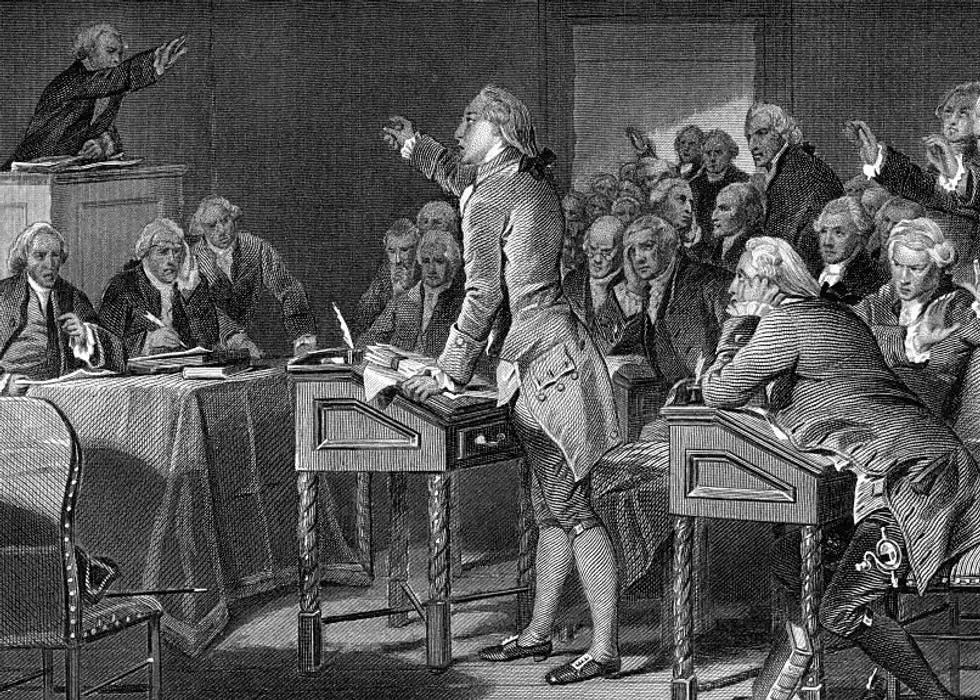
By the time Virginia Convention was convened in Richmond on March 20, 1775, the fiery oratory of Patrick Henry was already legendary. He had taken on the established church in the Parsons Cause and he actively continued to defend unlicensed preachers in Virginia. He led the opposition in the House of Burgesses against the Stamp Act a decade earlier and was already one of the leading political figures in America.
Before he left for Virginia after the First Continental Congress, he met with John Adams for dinner and discussed the situation. Adams read to him a letter from a friend back in Massachusetts urging a military plan of action. Adams would later write, “In the Congress of 1774, there was not one member, except Patrick Henry, who appeared to me sensible of the precipice, or rather, the pinnacle on which we stood, and had the candor and courage enough to acknowledge it.”
As he traveled back home to Virginia, the question of what to do weighed heavy on Henry. But upon his arrival home, he would be greeted with devastating news – his wife, Sarah, who had long suffered from an unknown illness, was very sick and near death. But the urgent matters of state could not wait.
Governor Dunmore had refused all requests to reconvene the House of Burgesses, and an effort was underway to call a convention to discuss how the colony would respond to the growing British threat. The Hanover County Committee elected Henry to represent them at the convention on February 18th, but he was absent from the proceedings. Just a week earlier, his wife had died. He told his closest friends how deeply his wife’s death grieved him, but he also felt that he couldn’t disappoint the people of Virginia in their hour of need.
The Virginia Convention gathered at St. John’s Church in Richmond with all the leading men of the colony present. The first order of business was a discussion of what had transpired during the Congressional sessions in Philadelphia and to share news of the ongoing siege of Boston from the various committees of correspondence. The news was not encouraging, and many leaders in the other colonies were uncertain how to respond.
Despite his grief and recent personal loss, Patrick Henry was in attendance and put forward a motion for Virginia to take defensive measures against the British threat and prepare plans for calling and arming the militia. The convention was split on the motion. Richard Henry Lee and several of the more militant members supported Henry. Others, such as Peyton Randolph, were cautious that such a move might provoke the British to bring troops to Virginia and impose order. If approved, Henry’s motion could very well mean war. But everyone there knew that by discussing the motion, the convention was already flirting with treason. Henry was making a bold move.
Discussion raged back and forth between the convention members. No one, including Henry, was anxious for an armed conflict against what was then the greatest commercial and military power in the world. But he concluded that the time for talk and half-measures was over – immediate action was necessary. Failure to do anything would leave Virginia and the whole of America vulnerable to attack by the British.
Having heard his proposal denounced as going too far, he asked to speak. Rising from the church pew with determination, he knew that the other members of the convention had to be brought to the point where they acknowledged the gravity of the situation. He began his address by acknowledging that despite their differences, all of those present were friends and apologized in advance to those who disagreed with him for the bold statement he was about to make. This was no time for polite conversation: “The question before the House is one of awful moment to this country. For my own part, I consider it as nothing less than a question of freedom or slavery… Should I keep back my opinions at such a time, through fear of giving offense, I should consider myself as guilty of treason towards my country, and of an act of disloyalty towards the majesty of Heaven, which I revere above all earthly things.”
Now that he had everyone’s attention and had created in his hearers’ minds a sense of anticipation, he wanted to state his case as clearly as possible. Surely, everyone wanted peace, but they had to recognize the threat that the British troops represented. Arriving more and more every day, they were not intended to bring peace, but submission. “Has Great Britain any enemy in this quarter of the world, to call for all this accumulation of navies and armies? No sir, she has none. They are meant for us: they can be meant for no other. They are sent over to bind and rivet upon us those chains which the British ministry have been so long forging.”
Directing his rhetorical prowess to the arguments of those who wanted to make further appeals to the king, he said, “Our petitions have been slighted; our remonstrances have produced additional violence and insult; our supplications have been disregarded; and we have been spurned with contempt from the foot of the throne.” The concern was not just with Lord North or the Parliament – this policy of submission extended all the way to the king. Having identified that the problem started at the top and worked its way down to the colonies, there was no room left to hope for yet another appeal to the king. “We must fight! I repeat it sir, - we must fight! An appeal to arms, and to the God of hosts, is all that is left us.”
Their attention now drawn away from the arguments at hand, he had to address their fears about the British might. “Sir, we are not weak, if we make a proper use of those means which the God of nature hath placed in our power. Three millions of people armed in the holy cause of liberty, and in such a country as that which we possess, are invincible by any force which our enemy can send against us.”
Growing all the more bold and speaking now like an Old Testament prophet, he assured them that because their cause was just, their hope should be in the Lord. “There is a God who presides over the destinies of nations, and who will raise up friends to fight our battles for us. The battle sir, is not to the strong alone: it is to the vigilant, the active, the brave.” Henry now had to make sure that everyone understood that there was only one course of action to follow. “There is no retreat but in submission and slavery. Our chains are forged. Their clanking may be heard on the plains of Boston. The war is inevitable. And let it come! I repeat it, sir, let it come!”
Summoning what strength he had left in him, he challenged his colleagues to be men of purpose; men of virtue; men of action. “Why stand we here idle? What is it that gentlemen wish? What would they have? Is life so dear, or peace so sweet, as to be purchased at the price of chains and slavery? Forbid it Almighty God!” With his audience sitting motionless and hanging seemingly on every word, Henry wanted those present to have no lingering doubts about where he stood or what was at stake. “I know not what course others may take, but as for me,” he said throwing a defiant fist in the air, “give me liberty,” and now bringing his hand down to his heart as if holding a dagger, “or give me death!”
Patrick Henry had made his case. The atmosphere in St. John’s Church was electric and yet deathly silent. And as he sat down in the pew, one observer later recalled that the words, “to arms,” quivered on every lip. Another listener was so moved as he stood outside and listened through an open window in the church, that he requested to be buried on that spot – a request that was granted at his death. Henry had thrown down the gauntlet, and the members of the convention would pick it up.
His motion was approved. Virginia, and all of the other American states with her, was now preparing for independence – and war.