
Great Awakening

“The foundations of our society and our government rest so much on the teachings of the Bible that it would be difficult to support them if faith in these teachings would cease to be practically universal in our country.” Calvin Coolidge
Despite the diverse backgrounds in all of the American colonies, the Christian faith played a significant, if not dominant, role in their founding and settling. Whether in the Puritan holy commonwealths of New England, in the Cavalier commercial establishments of the Middle Colonies, or in the revivalist utopias of the South, each of the colonies were distinctly Christian in purpose, vision, and culture. Their charters, legal systems, social structures, commercial compacts, and political covenants were indisputably and unhesitatingly Christian. America was founded on zeal for Christ and His Kingdom.
But as generations passed the religious fervor that had led many to the New World began to fade, and church leaders across the colonies, particularly in New England, began to fret about the dampening of spiritual influence in the lives of the colonists. The malaise was predictable, if not understandable. The colonies were expanding and becoming more focused on matters of commerce and convenience. Personal peace and affluence became more important to many than the ideas and ideals that made such aspirations possible in the first place. As Cotton Mather asserted, the Christian faith had brought the colonies prosperity, but “the daughter destroyed the mother—there is a danger, lest the enchantments of this world make them forget their errand into the wilderness: to build a city on a hill, an illumination for all the world.”
It seemed that there was little to disturb the colonists’ pursuit of the “good life.” Back in Britain, for instance, the succession crisis following the death of Queen Anne kept Parliamentary attentions diverted to the problems back home, leaving the colonies to themselves.
But even as Puritan pastors issued grave warnings and fierce jeremiads a sudden renewal movement shook off the colonial spiritual malaise, swept across whole communities, and dramatically reshaped the cultural dynamics of the New World. The Great Awakening is the designation generally given to the series of revivals that occurred throughout the colonies in the period between 1720-1750, reaching its zenith toward the end of 1746 or the beginning of 1747. These revivals began on a small scale in the Connecticut River Valley, and would sweep up and down the Atlantic seaboard for the next few decades, reaching up to Maine and all the way down to Georgia.
The cumulative effects of this movement could be felt in the dramatic shift in communications, which resulted in closer relations of individuals, communities and churches across the colonies. The theology that emerged from the Great Awakening redefined spiritual relationships, focusing more on the individual than on the community, creating ripple effects in the social and political structure of many colonies. It also created a common evangelical culture with a shared language that emphasized certain themes, such as liberty, virtue and tyranny, which would take on more than just spiritual meaning in the years ahead. As historian Mark Shaw once said, “What was awakened in 1740 was the spirit of independence.”
The Building Wave
Though he was prefigured by many of the New England Puritan stalwarts who came before him, the first prominent figure of the Great Awakening was Jonathan Edwards. He was a Congregationalist pastor of the very prominent Puritan church in Northampton, Massachusetts. Edwards had assumed the pulpit upon the death of his grandfather, Solomon Stoddard, who had served as pastor for the church for many years and who had seen several periods of renewal in his own time. In late 1734, as Edwards was preaching a sermon on justification by faith, the members of his church began to be stirred by a conviction of their sin and a desire to live their lives more fully devoted and in obedience to Christ. Over the course of the next several weeks and months the town seemed to be transformed. Innumerable souls were converted. The church was crowded. Morals were discernibly altered. And then, the awakened spiritual affection in Northampton quickly spread to several neighboring towns in rural Massachusetts. Every aspect of life and culture seemed to come under the gracious influences of the Gospel.
Almost immediately, opinion amongst the clergy about the revivals was sharply divided. In response, Edwards authored a defense of the revivals, the Faithful Narrative of the Surprising Work of God, which described the events as nothing less than “the work of God.” Copies of Edwards’ revival account were soon circulating back in England, encouraging revival-minded pastors and raising concerns for the Anglican clergymen already troubled by their weak presence in America.
At about the same time in New Jersey, a Dutch Reformed pastor, Theodore Frelinghuysen, was seeing very similar responses in his church and the surrounding community as he preached on the need for personal conversion experience, the necessity of holiness in the Christian life, and observing strict standards for admitting congregants to communion.
Similarly, William and Gilbert Tennant, father and son Presbyterian firebrands, thundered calls for the prosperous American colonial churches to humble themselves in true repentance. Their fire and brimstone message struck a chord, and they too saw hundreds of changed lives—and a dramatically changed culture as well.
The most comprehensive spiritual awakening since the time of the Reformation soon engulfed most of the colonies.
Revival Aflame
The watershed of the Great Awakening was the arrival of George Whitefield from England in 1738 to aid in the establishment of an orphanage in Georgia. He had recently graduated from Pembroke College at Oxford, where he developed a strong friendship with another student interested in living a deeper Christian life, John Wesley. He had become quite a celebrity back in England, having preached revival to enormous outdoor crowds in London and Bristol. Returning to England, he was ordained an Anglican pastor, and he returned to the colonies in 1739.
But it was on his tour of America in 1740 that the embers of revival would be fanned into full flame. Arriving in Savannah, he would preach to massive crowds in New York, Philadelphia, Boston and Charleston, the largest cities at the time, and extensively tour New England from York, Maine to New Haven, Connecticut. He also found time to travel to the backwoods of Northampton to meet Jonathan Edwards and observe the work there.
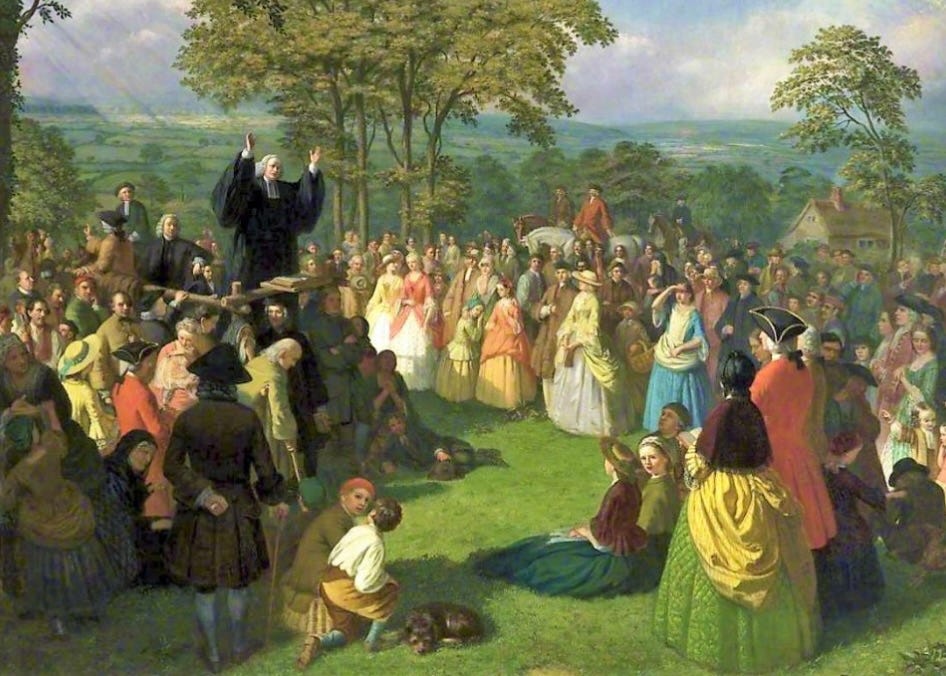
The crowds, gathered in fields, in town squares, and along roadsides. Numbering in the thousands at virtually every stop along the way, the throngs were attracted by Whitefield’s unique preaching style. Rather than reading from his sermon notes, he spoke extemporaneously and with dramatic flare. Discarding the genteel and formal language of aristocratic society, he spoke openly and directly to the common man, which endeared him to the members of the lower classes. When the churches were closed to him, or the crowds grew to large for any building to hold, he would speak outdoors, as he previously had in England. Many eager listeners traveled for days to hear him speak, and many thousands, spurred by Whitefield’s message of the necessity of conversion, dedicated their lives to Christ.
Even diehard skeptics, like Benjamin Franklin, were impressed with the results of his preaching. “It was wonderful,” Franklin said, “to see the change soon made in the manners of our inhabitants. From being thoughtless or indifferent about religion, it seems as if all the world were growing religious, so that one could not walk through the town in an evening without hearing psalms sung in different families of every street.” While Franklin apparently never embraced the Christian faith, he maintained a friendship with Whitefield that lasted for years, became his American publisher, and promoted the cause of the awakening from that day forward.
Whitefield would eventually make seven trips to America over the next thirty-four years, dying during the last in September 1770. In that time, he would become the first celebrity recognized in every colony, in every region, and in every city in America. In the process he would radically alter the spiritual landscape of the budding American nation.
A Church Divided
Now that revival was aflame throughout the colonies, few churches were left untouched. It was the topic of conversation at virtually every dinner table. The clergy began to divide between those who wanted to embrace the revivals and integrate its popular message, called the New Lights, and those who rejected it entirely as mass hysteria or saw it as a threat to the established social hierarchy and turned their back on the new converts—the Old Lights. Although he was ordained as an Anglican, Whitefield frequently found those church doors closed to him. Once in Boston, a prominent Anglican minister expressed his disapproval directly, and said, “Mr. Whitefield, I am sorry to see you here,” which prompted the revivalist to reply, “Yes, and so is the devil.”
This exchange is indicative of how deeply the faults within the American church were growing. While the Great Awakening was uniting rich and poor, young and old, and members of every religious group—Congregational, Baptist, Presbyterian and Anglican—the revivals were also dividing people. While the movement would create an extensive evangelical culture that would allow pastors and churches of all backgrounds to work together, the different responses it provoked would create the divisions that would lead to the fracturing of several church organizations, spawning the denominational divisions that have marked American religious life ever since.
A New National Calling
Because of the growing national relevance of personal faith due to the effects of the Great Awakening, there was an increased awareness of how important religious liberty was to advancing the cause of Christ. The great Baptist leader of the time, Isaac Backus, emphasized that the gospel of grace could only take root in a culture that allowed for the freedom for it to be proclaimed. George Whitefield also often warned that political liberty could never be compromised without risking the integrity of spiritual liberty as well. He foresaw the danger that a conflict between the colonies and Britain might pose to the ongoing work of the gospel. Speaking to a crowd in Portsmouth, Massachusetts in 1764, he said: “I can’t in conscience leave the town without acquainting you with a secret. My heart bleeds for America. O poor New England! There is a deep-laid plot against both your civil and religious liberties, and they will be lost. Your golden days are at an end. You have nothing but trouble before you.” He would not live to see how prophetic his words were.
The renewal movement not only awakened communities to spiritual and political realities, it also reinvigorated the rest of the culture through the recovery of the ideas of vocation and calling. The Reformers held that all Christians could participate in the building of the Kingdom of God, not just the ordained clergy, such that believers looked to conduct the whole of their lives in accordance with God’s Word. This theme fit well with the Great Awakening emphasis on the necessity of Christian obedience. Since the message of revival took root with all classes, workers and merchants alike labored with a new vigor in their occupations, filled with a sense of destiny and a calling to build a Christian society. As a result, craftsmen began to outshine their counterparts back in Europe, and entrepreneurs began building wealth to invest in the City of God.
Those touched by religious revival would wisely use those resources. One area in which they were directed was the humanitarian concern that grew out of the interaction between people of differing ethnic, religious and economic backgrounds. New attention was directed towards the plight of slaves, and an effort to end the practice began to take root. In fact, a ten-year old boy who heard one of Whitefield’s last sermons, William Wilberforce, would grow up to single-handedly fight to end the practice in England. A missionary effort to evangelize the Indian tribes also grew out of the Great Awakening, as men like David Brainerd, a friend of Jonathan Edwards, ventured out into the wilderness to share the gospel with Indian tribes.
Educational institutions also sprung up as Christian leaders directed their attention to ensure that there were enough pastors to minister to the newly converted, and to train cultural leaders to extend the benefits of the Christian message into all spheres of life. In 1726, as the first revivals were taking place, William Tennant founded the “Log College” to train pastors, who became an active presence throughout the colonies as the Great Awakening took hold in the succeeding years. It would later become the College of New Jersey and then would be renamed Princeton. As the revival waves crashed along America’s shores, religious organizations would found a number of other new colleges that are still important to our national life: Brown University, founded by Baptists in 1760; Queens College (later renamed Rutgers), a Dutch Reformed institution established in 1764; and Dartmouth College, founded by Congregationalist pastor Eleazar Wheelock in 1769.
Spiritual Reinforcements Arrive
The Great Awakening had an enormous impact on the national life of the colonies, but its effects would be bolstered as a massive tide of Scots-Irish Presbyterian allies would appear on the American scene. The dimensions of the mass Scots-Irish exodus to America was staggering. Between 1725-1768, tens of thousands left Ireland for America. Nearly all were Protestants; most were Presbyterians. The migration began in 1714, and continued in 1717-1718, when Anglo-Irish landlords began to raise rents on the religious dissenters. Poor harvests and famines forced more to leave in 1728 and 1740-1741. In the later part of the 1740s, more than 12,000 a year would arrive on the shores of the New World.
Political troubles in Scotland were a contributing factor to the population shift. The defeat of the Stuart claimant to the English throne, Charles Stuart, known as “Bonnie Prince Charlie,” and the massacre of his Scottish supporters at the Battle of Culloden in 1745 prompted George II to embark on a policy of clearing out the Scottish Highlands of his enemies. The purge of the Scottish clans from their lands and the suppression of traditional Scots culture—the old kilts, tartans, ballads, and even the Gaelic would drive many to the New World, putting distance between them and their religious and political enemies—the English. Between 1746 and 1766 nearly half the adult population abandoned Scotland—and for decades afterward the stream of immigrants to American continued unabated in what came to be known as the Highland Clearances.
In terms of the Great Awakening, the timing couldn’t have been more perfect. At the moment when the demand for trained pastors and church leaders was greatest as the revivals were at their peak, whole armies of catechized Presbyterians disembarked from ships arriving from Scotland and Northern Ireland. Despite their small populations, they would eventually outpace the English in relocating to America. Between 1763-1775, only 30,000 English immigrants would arrive in the colonies, compared to 95,000 Scots-Irish refugees. Not only did these new arrivals share the Calvinistic theological beliefs of Whitefield and Edwards, but they were also equally suspicious of the Anglican church establishment that had chased them from their homelands, and were now denouncing the revivals in America.
No better marriage could have been made. The Presbyterians were welcomed enthusiastically by the revival leaders and immediately integrated into colonial society. They also served as shock troops to extend the religious movement as they settled along the frontier from the Georgia uplands, into what is today Kentucky and Tennessee. By 1775, 200 new communities founded by the Scots-Irish immigrants blossomed in these areas. And they made their presence felt in established territories as well. Ben Franklin estimated in 1776 that there were 350,000 Presbyterians in Pennsylvania alone, representing one-third of the population of the entire colony. They also settled in the Shenandoah and Blue Ridge Valleys of Virginia, drastically altering the cultural landscape and setting the stage for a series of skirmishes with the established Anglican clergy there.
The arrival of the Scots-Irish in America flooded the revival movement with new workers and active supporters. As tensions between the colonies and Parliament escalated into armed conflict, it would be these communities that voiced their anti-imperial sentiments and banded together to organize the resistance. Since many of the Scots brought their military experience, along with their virulent hatred of the English, with them to America, they would play a key role in the establishment of the colonial militias. The War for Independence would vindicate many causes that had been fought and lost to the British in earlier conflicts back in the motherland.
The Overall Impact
The Great Awakening would see many leaders rise up to take the challenge of evangelizing the world seriously. Because of the spiritual lethargy of the early 18th Century, the revivals were a breath of fresh air for the Christian church in the New World struggling to define its existence.
There were significant religious and theological consequences as a result of this tremendous movement of the Holy Spirit. Churches grew dramatically. And involvement in churches by long-time members was greatly strengthened. The awakening encouraged personal obedience and holiness, and revived the notion of Christian duty. It also served to create a unified evangelical culture. Despite continuing theological differences and distinctions, the communication and cooperation between the clergy and membership of a number of denominations increased, both locally and between colonies. A bond of fellowship was formed that would serve as a cultural glue in the years ahead.
In several cases, however, it could not keep religious groups from splitting apart. As the revivalist New Lights confronted and challenged the authority of the Old Lights, the two camps drifted further from each other. As the New Lights spoke of the religious impact on individuals, the Old Lights defended the church hierarchy as necessary to maintain social order. As the rift widened, the result was the birth of denominationalism, which ran counter to the unifying and cooperative trend of evangelicalism.
Vocalizing their opposition to the gospel of grace, the Old Lights began to reject the teachings of the Reformation and embrace Deism, which eventually drifted into Unitarianism in New England. Amongst the evangelicals, however, the popularized Calvinism of Whitefield and Edwards strengthened the burgeoning Baptist movement and reversed those churches’ slide into Liberalism, Arminianism, and Unitarianism.
There were many cultural effects as well. The Great Awakening attracted young believers who would sustain the religious and cultural gains of the movement for several decades. The new colleges and educational institutions established by the revivalist religious groups would teach and train these leaders to integrate their new religious faith in every sphere of their lives.
Furthermore, those religious groups that held onto the revival teachings would grow much faster than the Anglican Church, which was hampered in their limited evangelism efforts by the absence of any resident bishop, who could have presided over and directed the church’s affairs in the colonies, and the requirement of those seeking to enter the ministry to travel to England for their education and ordination. This would prove to be a significant barrier as other denominations trained their best and brightest in America, and put them immediately in the field where they were needed.
Thus, much of the population would grow distant from the English church-state establishment, and grow to resent it. This embedded dissent in America would manifest itself later as the colonials grew hostile to any established religion. This did not mean that they were hostile to the Christian faith – quite the contrary – but it did contribute to a trend of secularization that would take hold later in the 18th Century.
New missionary zeal was aimed at the frontier communities, the Native American Indians, and the transplanted Africans—both slave and free. The awakened church was much more evangelistic and mission-minded than ever before—and thus the hallmark of evangelicalism became a dominating distinctive of American life.
The Great Awakening also exposed the cultural decay in New England Puritan society that had lost its way since the first generation of founders who came to America intent on building a Christian commonwealth. And while that was still a noble cause, the Calvinistic social theory those cultures were built from, which emphasized community as much as the individual, would later be replaced by Enlightenment teaching, which would transfer the struggle for a virtuous society from the religious to the political realms.
Formation of a Nation
Possibly the greatest impact of the Great Awakening was the creation of an American nation—as a social reality if not yet a political reality. The colonies, with different governments, geography, climate, industry and heritage, began to coalesce into a cultural whole. A whole new mode of popular communication that broke with the formal modes of discourse and transcended class distinctions now traveled along communication networks that extended from the cities to the very edges of the frontier. The revivals affected virtually every region of the country, and had ripples that extended into a number of areas of life. Unfortunately, several regions, such as Canada, at this time still under the domination of the French, and the Gulf Coast colonies in the South, missed the revivals and the associated cultural benefits.
This new nation would be established on the basis of a common religious and political vision and would develop a comprehensive vocabulary of freedom, which was characterized by a dominant them of virtue in religion and government. A letter published by the Virginia Gazette in June 1769 embodies this hope, for it says, “The prevailing principle of our government is virtue…We must be more attentive to it than we hitherto have been: By that only can liberty be preserved…By virtue, I here mean a love for our country, which makes us pursue, with alacrity, such measures as tend to its preservation, and cheerfully resist the temptations of ease and luxury with which liberty is incompatible.”
During this time, the emerging American nation would develop a kind of national creed. It would be expressed in a language of liberty it appropriated from the Great Awakening—freedom from tyranny, personal responsibility and a life of action. While the revivalists never could have anticipated the application of their religious principles to the cultural and the political, these themes would thunder as commands from the revolutionary pulpits in the decades to come. The religious revivals provoked a colossal shift in identity in the colonies as the attachments to the Old World eroded and as colonists challenged their existing allegiances as the conflicts in Europe drifted to the New World. The Great Awakening announced a new era in history, as historian Richard Bushman, in his book, From Puritan to Yankee, concluded, “A psychological earthquake had reshaped the human landscape.”
Would you consider Roman Catholics any part of this cultural, social, and religious movement?