
Boniface

Boniface of Crediton spent the first forty years of his life in quiet service to the church near his home at Examchester, as Exeter was known in the century before King Alfred. Boniface was by all accounts a loving pastor, teaching the good news of the Gospel Sunday by Sunday, discipling young converts, caring for the sick, and administering relief for the poor. He was a competent scholar as well, expounding Bible doctrine for a small theological center and compiling the first Latin grammar written in England.
But in 718, Boniface left the comfort and security of this settled life to become a missionary to the still-savage tribes of Germania. For the next thirty years he not only proclaimed to them the Gospel of Light, he portrayed to them the Gospel of Life. He was constantly jeopardizing his own life for the sake of the young, the vulnerable, the weak, the helpless, the aged, the sick, and the poor—often imposing his body between the victims and their oppressors. Stories of his courageous intervention on behalf of the innocent abound. Indeed, it was during one of his famed rescues that his name was forever linked to the celebration of Advent during Yuletide.
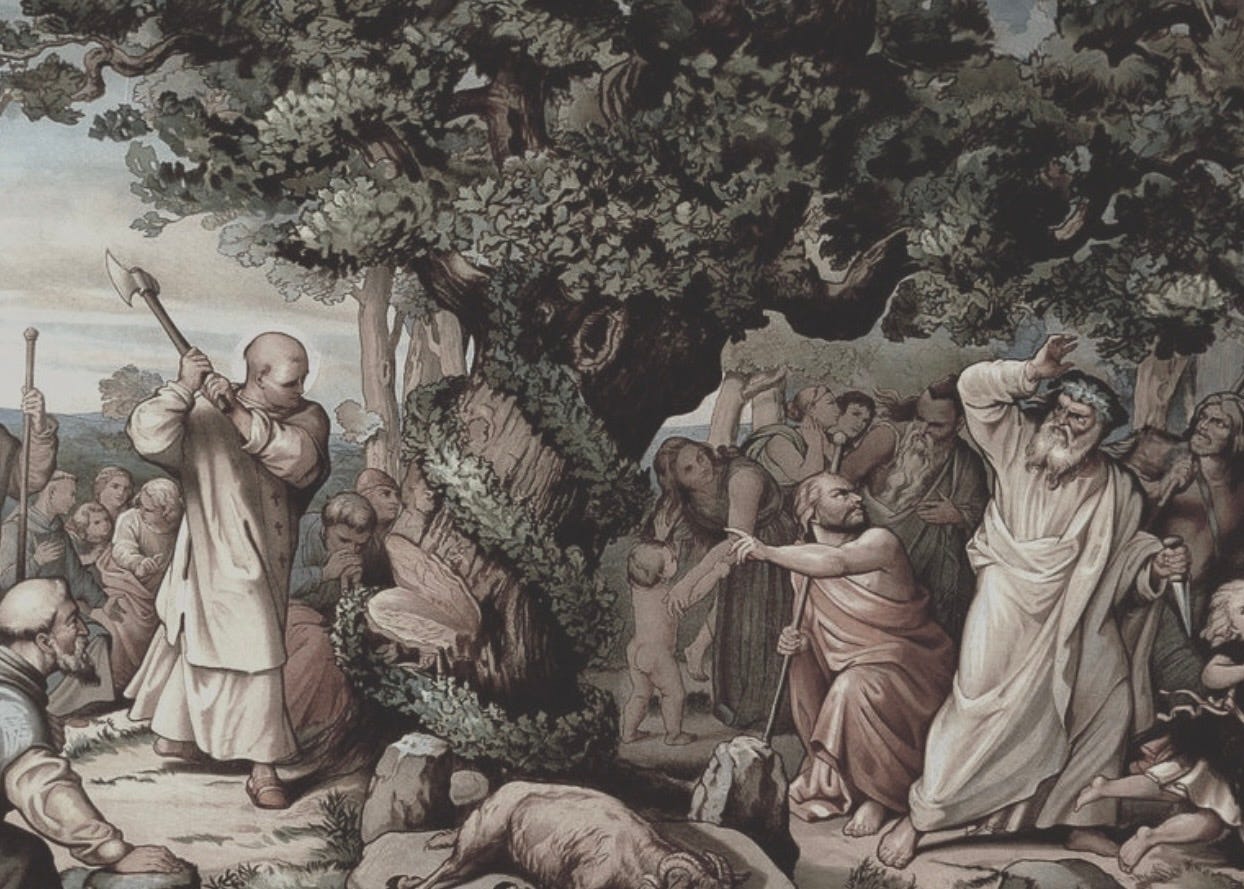
Wherever he went among the fierce Norsemen who had settled along the Danish and German coast, he was forced to face the awful specter of their brutal pagan practices—which included ritual tortures and human sacrifices. When he arrived in the region of Hesse, Boniface decided to strike at the root of such superstitions. He publicly announced that he would destroy their gods. He then marched toward their great sacred grove. The awestruck crowd at Geismar followed along and then watched as he cut down the sacred Oak of Thor, an ancient object of pagan worship standing atop the summit of Mount Gudenberg near Fritzlar. The Druid priests, who had expected immediate judgment against such sacrilege, were forced to acknowledge that their gods were powerless to protect their own sanctuaries. In large numbers, they professed faith in Christ.
A young boy from a neighboring village, hearing of such boldness, rushed into the missionary camp of Boniface three evenings later. It was just about twilight on the first Sunday in Advent. He breathlessly told of a sacrifice that was to be offered that very evening—his sister was to serve as the vestal virgin.
Hurrying through the snowy woods and across the rough terrain, Boniface and the boy arrived at the dense sacred grove just in time to see the Druid priest raise his knife into the darkened air. But as the blade plunged downward Boniface hurtled toward the horrid scene. He had nothing in his hands save a small wooden cross. Lunging forward, he reached the girl just in time to see the blade of the knife pierce the cross—thus, saving her life.
The priest toppled back. The huddle of worshipers were astonished. Their was a brief moment of complete silence. Boniface seized upon it. He proclaimed the Gospel to them then and there, declaring that the ultimate sacrifice had already been made by Christ on the cross at Golgotha—there was no need for others.
Captivated by the bizarre scene before them, the small crowd listened intently to his words. After explaining to them the once and for all provision of the Gospel, he turned toward the sacred grove. With the sacrificial knife in hand, he began hacking off low hanging branches. Passing them around the circle, he told each family to take to the small fir boughs home as a reminder of the completeness of Christ’s work on the tree of Calvary. They were to adorn their hearths with the tokens of His grace. They might even chop great logs from the grove as fuel for their home fires, he suggested—not so much to herald the destruction of their pagan ways but rather to memorialize the provision of Christ’s coming. Upon these things they were contemplate over the course of the next four weeks, until the great celebration of Christmas.
Such exploits inspired a number of Advent traditions. The Advent wreath—a fir garland set with five candles, one for each Sunday in Advent and one for Christmas Day—was quickly established as a means of reenacting the Gospel lesson of Boniface. In addition, the Christmas tree, decorated with candles and tinsel, strings of lights and garlands under the eaves and across the mantles, and the Yule log burning in the fireplace were favorite reminders of the season’s essential message.
In time, Boniface established a large number of thriving parishes all across the frontiers of northern Europe. He eventually became a mentor and advisor to the Carolingians, and he helped to reform the Frankish church, which Charles Martel had plundered. Ultimately, he discipled Pipin the Short, the father of Charlemagne the Great. He boldly declared, “Let us standfast in what is right and prepare our souls for trial. Let us be neither dogs that do not bark, nor silent onlookers, nor paid servants who run away before the wolf.”
The disciples of Boniface, including Willibald, Gregory, Luidger, and Lullus, were the progenitors of what came to be known as the Cathedral School Movement. These initially modest institutions would in turn help to spawn the great monastic libraries and the first universities throughout Christendom. It is because of this that Boniface has sometimes been named alongside the “Nine Worthies,” as a fit exemplar of the Medieval chivalric ideal.
At age 70, Boniface resigned from his many pastoral responsibilities, in order to spend his last years working among the fierce Frieslanders. With a small company, he successfully reached large numbers in the previously unevangelized area in the northeastern German tribal lands. On Whitsun Eve Boniface and one of his faithful disciples, Eoban, were preparing for the baptism of some of the new converts at Dokkum, along the frontier of the Netherlands. Boniface had been quietly reading in his tent, awaiting the start of the service, when a hostile band of barbarian warriors descended on the camp. Boniface exhorted the huddle of believers to trust in God and if need be even to welcome the prospect of dying for the faith. Alas, when the attack came, Boniface was one of the first to fall.
Though his voice was stilled that day, his testimony only grew louder, surer, and bolder. And thus, to this day, his message lives on—in the traditions of Advent.
A faithful minister of the Lord indeed. I've never heard the story of him chopping down the pagan tree told with such dramatic prose, I was hooked!